I remember sitting in a windowless conference room about four years ago, staring at a whiteboard that looked like a plate of spaghetti. There were arrows pointing everywhere, three different colors of sticky notes, and a client: let’s call him Jim: who looked like he hadn't slept since the Obama administration. Jim was the Executive Director of a mid-sized non-profit, and he was drowning.
"Brett," he said, rubbing his eyes, "we have a process for everything, but nothing actually gets done."
If I’m honest... I’ve been Jim. I’ve been the guy who thought that if I just bought one more software subscription or drew one more flowchart, the "chaos" would suddenly transform into a well-oiled machine. It doesn't work that way. I’ve spent over a decade in the trenches of operational consulting, and if there is one thing I’ve learned, it’s that "process improvement" is often just a fancy term for "stop doing stupid stuff."
We don’t do fluff here. We do solutions. So, if you’re looking for a 400-page manual on Six Sigma theory, you’re in the wrong place. But if you want to know how to actually fix your business so you can go home at 5:00 PM without your phone vibrating off the nightstand... keep reading.
The "Process Improvement" Myth
Most people think process improvement is about adding things. They think they need more steps, more checks, and more meetings to "ensure quality." Yikes. Usually, the opposite is true. True improvement is almost always about subtraction.
When I walk into a company, the first thing I look for isn't what’s missing... it’s what’s clogging the drain. We call this "Operational Debt." It’s the collection of "we’ve always done it this way" habits that are slowly killing your team’s soul.
Have you ever felt like your team is running at 100mph but the car isn't moving? That’s not a personnel problem. It’s a process problem. To fix it, we have to get back to basics. We use a triage framework I call Reduce -> Route -> Resolve.
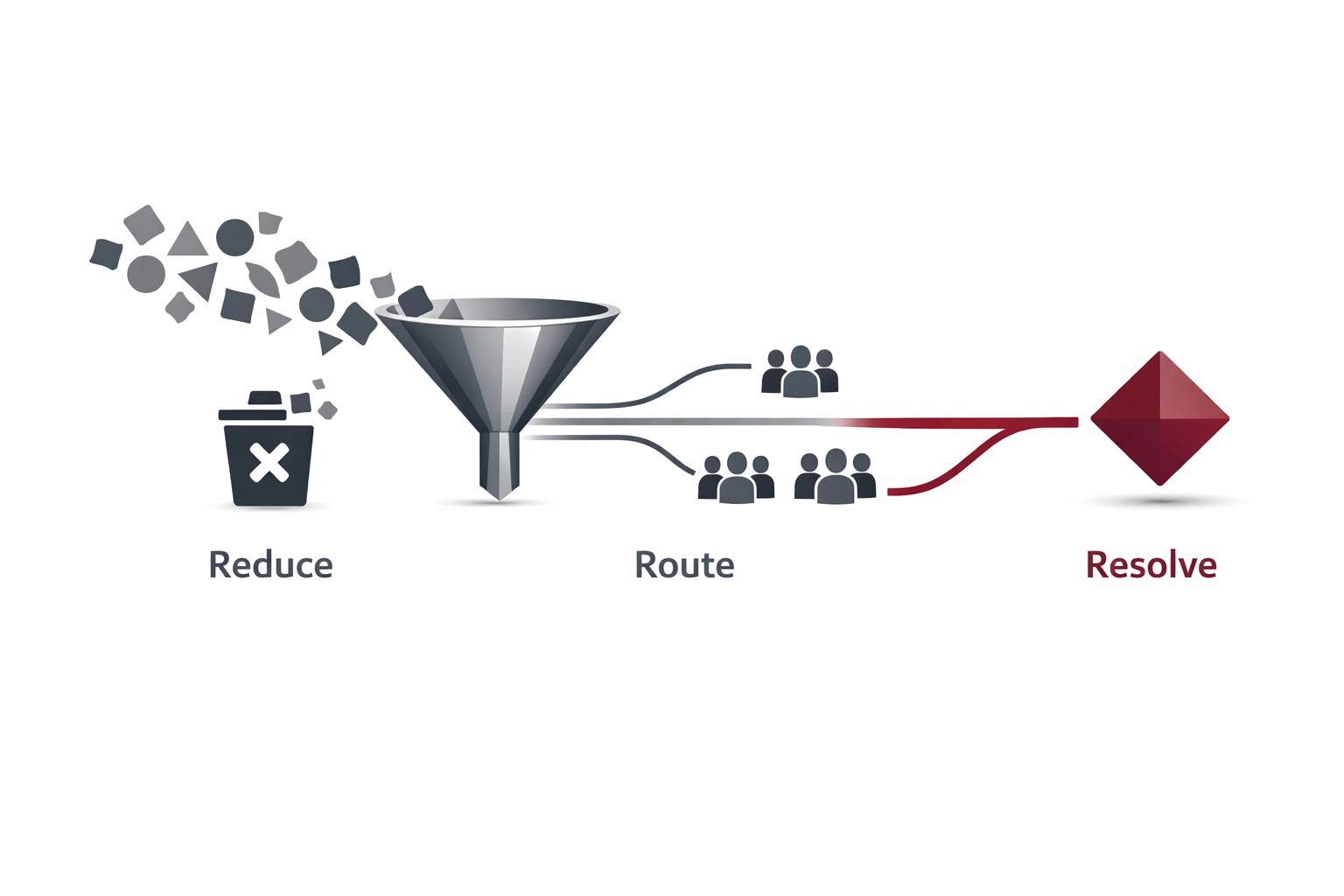
The Framework: Reduce -> Route -> Resolve
If you’re a leader, your time is your most precious resource. But most leaders I meet are spending 80% of their day on things that don't require their specific genius. To fix your operations, you have to run every single task through this filter:
1. Reduce
The first step isn't to make a process better; it's to kill it. If a task doesn't move the needle for your mission or your bottom line, why are you doing it? I’ve seen teams spend four hours a week on a report that nobody reads. We cut that report, and suddenly, the team has half a day back.
Ask yourself: If we stopped doing this today, who would actually suffer? If the answer is "no one," bury it.
2. Route
Once you’ve trimmed the fat, look at what’s left. Does it have to be you? (Spoiler alert: Usually, the answer is no). Routing is about getting the work to the "natural owner." This isn't just dumping work on someone else; it’s providing the context and the authority they need to actually finish it.
I struggle with this one myself sometimes... I like to be the "hero" who fixes things. But if I'm the only one who can fix the printer or approve a $50 expense, I’m not a leader: I’m a bottleneck. You need to route the work to the right person.
3. Resolve
This is the final stage. These are the tasks that actually require your judgment, your experience, and your unique perspective. By the time you get here, your to-do list should be small but heavy. This is where you actually do the work that only you can do.
Are You an "Independent" Leader?
In my world, the gold standard for an Executive Director (ED) or an owner isn't how much they do: it’s how little they have to do for the organization to thrive. I evaluate the health of a business based on how independent the organization is from the leader.
It sounds counterintuitive, right? You want to be "essential." But if you’re essential to every single decision, you’ve built a cage, not a business.
Here are the five indicators I use to see if an organization is truly healthy:
- Decision Levels: Are decisions being made by the people doing the work? If every decision has to travel up the mountain to the ED, your process is broken.
- Distributed Relationships: Does the ED own every major donor or client relationship? If so, the organization is one "bad day" away from a crisis. Key relationships should be spread across the team.
- Accessible Documentation: Are your core processes written down, or are they living inside someone’s head? If Sarah leaves and takes the "how to run payroll" secret with her, you don't have a process... you have a hostage situation.
- The Absence Test: What happens if the ED goes on a two-week vacation without Wi-Fi? If the office burns down (metaphorically or literally), you have work to do.
- Succession Planning: Are you actively training your replacement? Even if you plan on staying for 20 years, a leader who isn't developing others is just a manager with a better title.

Why Methodologies Like DiSC Matter
You can have the best process in the world, but if your team hates working together, it won't matter. I’ve seen "perfect" systems fail because the "C" (Conscientious) personalities were being forced to work like "i" (Influential) personalities.
This is why we lean so heavily on DiSC Training. Process improvement isn't just about software; it’s about people. If you understand how your team communicates, you can build processes that actually fit their natural strengths. For example, a "D" personality doesn't want a 10-step process; they want the goal and the authority to hit it. A "C" personality wants the data and the steps.
If you ignore the human element, your process improvement project will just be another "flavor of the month" that everyone ignores. You can read more about how miscommunication kills engagement here.
The Reality of Change (It's Messy)
I’d love to tell you that following these steps is easy. It’s not. It’s like wet cement... you have a very short window to get it right before it sets. And even then, someone usually walks through it and leaves footprints.
I’ve had projects where we mapped everything out, everyone agreed, and two weeks later... they were back to their old, broken ways. It’s frustrating. It makes me want to scream sometimes. But that’s where the "consulting" part of process improvement consulting comes in. You need a partner who is going to stand in the trenches with you and push back when you try to revert to your old habits.
To be honest, the best processes are the ones that are boring. They’re the ones that just work in the background so you don't have to think about them.
Stop the Fluff, Start the Solving
If your business feels like a constant fire drill, it’s time to stop looking for a better fire extinguisher and start looking at why the fires keep starting.
Process improvement isn't about being perfect. It’s about being better than you were yesterday. It's about taking that "spaghetti whiteboard" and turning it into a straight line.
I’ve seen organizations go from "barely surviving" to "thriving and scaling" just by implementing a few simple tweaks to how they route their work. It doesn't take a miracle; it just takes a willingness to look at the "way we've always done it" and ask, "Why?"
If you’re ready to stop wasting time on fragmented systems and actually get your life back, let’s talk. I don't have all the answers: nobody does: but I’ve seen enough "broken" to know what "fixed" looks like.
I’d love to hear from you. What’s the one process in your business that drives you absolutely crazy? Maybe we can solve it together.
Brett Bortnem is the Owner & Principal Consultant at Solved. Operations & Management Solutions. With over 30 years of experience, he helps businesses and non-profits stop the chaos and start growing. If you're interested in learning more about how to streamline your operations, check out our coaching services or join us at our next conference.