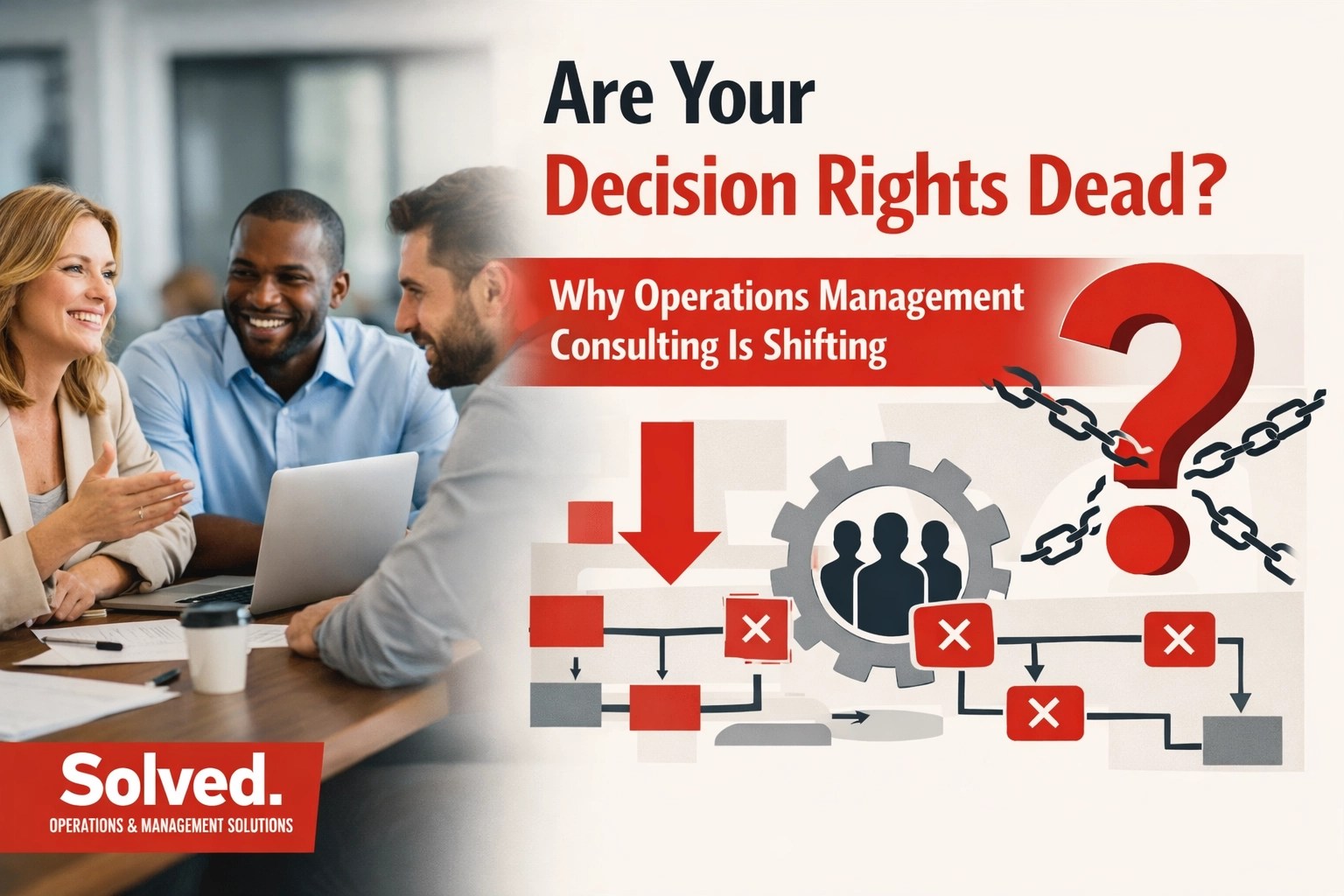
I remember sitting in a glass-walled conference room about three years ago, back when we still thought "hybrid work" was a temporary glitch in the matrix, and watching six highly paid executives stare at a single PowerPoint slide for forty-five minutes.
The air in the room was that specific kind of stale that only happens when people are afraid to speak up. The coffee was cold, my notepad was full of mindless doodles, and we were stuck. We weren’t stuck on a multi-million dollar merger or a massive pivot in the brand. No... we were stuck on who had the final "say-so" on the new employee onboarding workflow.
Everyone looked at the CEO. The CEO looked at the HR Director. The HR Director looked at the Operations Manager. It was a classic Mexican standoff, but with business casual attire and uncomfortable ergonomic chairs.
That’s the moment I realized that "Decision Rights", those fancy frameworks we consultants love to preach about, were, for all intents and purposes, dead in the water for most organizations. Or at least, they were dying a slow, bureaucratic death.
If you’ve ever felt that paralyzing "who is actually in charge of this?" sensation, you aren’t alone. And if I’m honest... I’ve been the one who built the overly complex charts that caused the paralysis in the first place. Yikes.
Today, the world of operations management consulting is undergoing a massive shift. We’re moving away from the "who does what" binders and toward something much more fluid, much faster, and (thankfully) much more effective.
The Ghost of RACI Past
In the old days of operations consulting, we worshipped at the altar of the RACI chart (Responsible, Accountable, Consulted, Informed). We’d spend weeks, and thousands of client dollars, mapping out every conceivable task to a specific person.
It looked great on a wall. It felt "organized." But the second a real-world problem hit the fan? Nobody checked the chart. They just sent an urgent Slack message to the person they liked the most or the person they thought wouldn't say no.
The problem is that traditional decision rights are static. They assume the world stands still. But in 2026, the world is moving at the speed of an AI-generated algorithm (more on that in a second). If your decision-making process requires a committee meeting and a cross-reference of a spreadsheet from 2022, you’ve already lost the race.

I’ve seen organizations where the "Decision Rights" were so rigid that people stopped taking initiative entirely. They’d say, "Well, it’s not in my box on the chart, so I’ll wait for a directive." That’s not a business; that’s a museum. And let’s be real... museums are great for looking at the past, but they aren't great at scaling impact.
Why the Shift is Happening Now
So, why is operations management consulting changing so drastically? Why can't we just stick to the old ways?
1. The AI Elephant in the Room
We can't talk about operations in 2026 without mentioning AI. We’re seeing a shift from human-centered decision rights to AI-informed (and sometimes AI-driven) decisions. When an automated system is handling your forecasting or scenario modeling, who owns the "right" to override it?
It’s a weird new world. We’re moving from "I think we should do X" to "The data suggests X, and my job is to facilitate the implementation of X." This changes the role of the strategic leader from a "Commander-in-Chief" to a "Systems Architect."
2. The Move Toward Outcome-Based Models
Consulting used to be: "Here is a diagnostic report. Good luck!"
Now, clients (rightfully) want skin in the game. At Solved. Operations & Management Solutions, we’ve seen that the best results come when the consultant doesn't just hand over a map but gets in the passenger seat. We’re moving toward shared risk and reward. If the decisions we help you make don't result in ROI, then we haven't done our job.
3. Integrated Implementation
The wall between "Strategy" and "Operations" has crumbled. You can’t have a strategy that doesn’t account for the daily grind of execution. This means decision rights have to be pushed down to the front lines. The person closest to the problem needs the "right" to fix it without waiting for three layers of management to chime in.

Are Your Decision Rights "Dead" or Just Sleeping?
How do you know if your organization is suffering from "Dead Decision Rights"? Here are a few red flags I’ve noticed (and I’ve definitely been guilty of ignoring these in my own past ventures):
- The "Meeting After the Meeting": You have an official meeting where a decision is "made," but then three people huddle in the hallway afterward to decide what they’re actually going to do.
- The Circular Approval: You need three signatures for a $500 expense, but a $50,000 mistake can go unnoticed for six months because "no one was technically responsible." (I know... it sounds crazy, but I’ve seen it happen in non-profits and corporations alike).
- The "Nice" Culture Trap: I’ve written before about why "nice" cultures struggle with conflict. If everyone is too "nice" to claim a decision right, no one actually makes the hard calls.
If this sounds like your team, don't panic. It doesn't mean you're a bad leader. It just means your operational "rhythms" are out of sync with the current reality.
How to Revive the Flow (Without More Binders)
If we’re moving away from static charts, what are we moving toward? Here is how we’re helping clients at Solved. approach this shift in operations management consulting:
Focus on "Decision Principles," Not Rules
Instead of a rule for every scenario, create principles. For example: "The person closest to the customer has the right to spend up to $200 to solve a problem instantly." That’s a principle. It’s flexible. It empowers. It prevents the 45-minute meeting about onboarding workflows I mentioned earlier.
Use Tools Like DiSC to Understand Your Deciders
Sometimes the "right" is there, but the "will" isn't. Some people are naturally hesitant to make a call without 100% of the data. Others will make a call with 10% of the data and hope for the best. Using DiSC assessment training helps you understand why your decision-making is stalled. Is it a process issue, or a personality clash? (Usually, it's a bit of both).

Embrace the "Wet Cement" Phase
I love the metaphor of wet cement. When you’re implementing a new operational change, the decisions should be treated as "wet." You can write in them, change them, and smooth them over for a period of time. Only after a "stress test" do you let them harden into a standard operating procedure.
This takes the pressure off. It allows for mistakes. And as someone who has made plenty of mistakes: believe me: the ability to pivot is much more valuable than the ability to be "right" the first time.
The Bottom Line
Decision rights aren't actually "dead": they’ve just evolved. They’ve moved from the boardroom walls into the daily workflows of your team.
The future of operations consulting isn't about creating more control; it’s about creating more clarity. When people know what they are empowered to do, they don't just work harder; they work smarter. They engage. They stay.
If you feel like your team is spinning its wheels... if you’re tired of the "meeting after the meeting"... or if you’re just not sure who is supposed to be steering the ship anymore... it might be time to look at your operations through a new lens.

I don’t have all the answers: nobody does: but I’ve spent enough time in those stale conference rooms to know that there’s a better way. We’re still learning, still iterating, and still finding ways to make operations feel less like a chore and more like a competitive advantage.
What about you? Have you felt that "decision paralysis" lately? Or have you found a "simple trick" that cleared the air for your team? I’d love to hear about it. Seriously. Let’s start a conversation.
Operational excellence isn't a destination; it’s a rhythm. Let’s find yours.
Brett Bortnem is the Owner & Principal Consultant at Solved. Operations & Management Solutions. He’s spent over a decade helping organizations navigate the messy, human side of business operations with a focus on engagement, clarity, and actual results.