I sat across the table from a non-profit Executive Director who looked... exhausted. Like, bone-tired exhausted.
She'd just spent fifteen minutes passionately explaining her organization's mission, serving unhoused families in the Twin Cities, providing dignity and pathways to stability. It was beautiful. Moving, even. The kind of mission that makes you want to write a check on the spot.
Then I asked a simple question: "How do you track which families you've served and what outcomes they're experiencing?"
Long pause.
"We... have a spreadsheet. Somewhere. I think Sarah has it? Or maybe it's in the shared drive..."
If you've been in non-profit leadership for more than a week, you've probably lived some version of this moment.
The Mission Trap (We've All Been There)
Here's the thing about mission-driven work, it's intoxicating. Your mission is why you show up. It's why your board members donate their time. It's what you lead with at fundraising events and in grant applications.
But here's what I've learned after years of working with non-profits: A compelling mission doesn't automatically translate into scaled impact.
I know... it feels almost sacrilegious to say that out loud.
Most non-profit leaders I meet can recite their mission statement in their sleep. They can paint a vivid picture of the world they're trying to create. But when I ask about their operational systems, how they deliver programs consistently, how they manage staff capacity, how they measure what's actually working, I get a lot of blank stares.
Or worse, I get: "We're too busy doing the work to worry about operations."

And that's precisely the problem.
What Operations Actually Means (It's Not Boring Admin Stuff)
Let's clear something up right now. When I talk about operations management consulting or operational consulting for non-profits, I'm not talking about fancy org charts or bureaucratic processes that slow everything down.
I'm talking about the infrastructure that allows you to serve more people without your Executive Director having a breakdown.
Operations is the answer to: How do we actually deliver on this mission? How do we do it consistently? How do we do it without burning out our three rockstar staff members who are already wearing seven hats each?
It's the difference between having a beautiful vision board... and having a functional vehicle that can actually drive you toward that vision.
Think of it this way: Your mission is your destination. Operations is your roadmap, your vehicle, your fuel, and your maintenance plan. You need both.
Why Non-Profits Struggle Without Operational Clarity
I've seen this pattern play out dozens of times:
A passionate founder starts a non-profit to address a real need in their community. They attract a dedicated board. They land a few grants. Programs launch. Impact happens.
Then they hit a wall.
They want to serve more families, expand to a new neighborhood, hire another program coordinator... but they can't. Not because they lack passion or funding (okay, funding is always tight, but still). They can't scale because their operational foundation is held together with duct tape and hope.
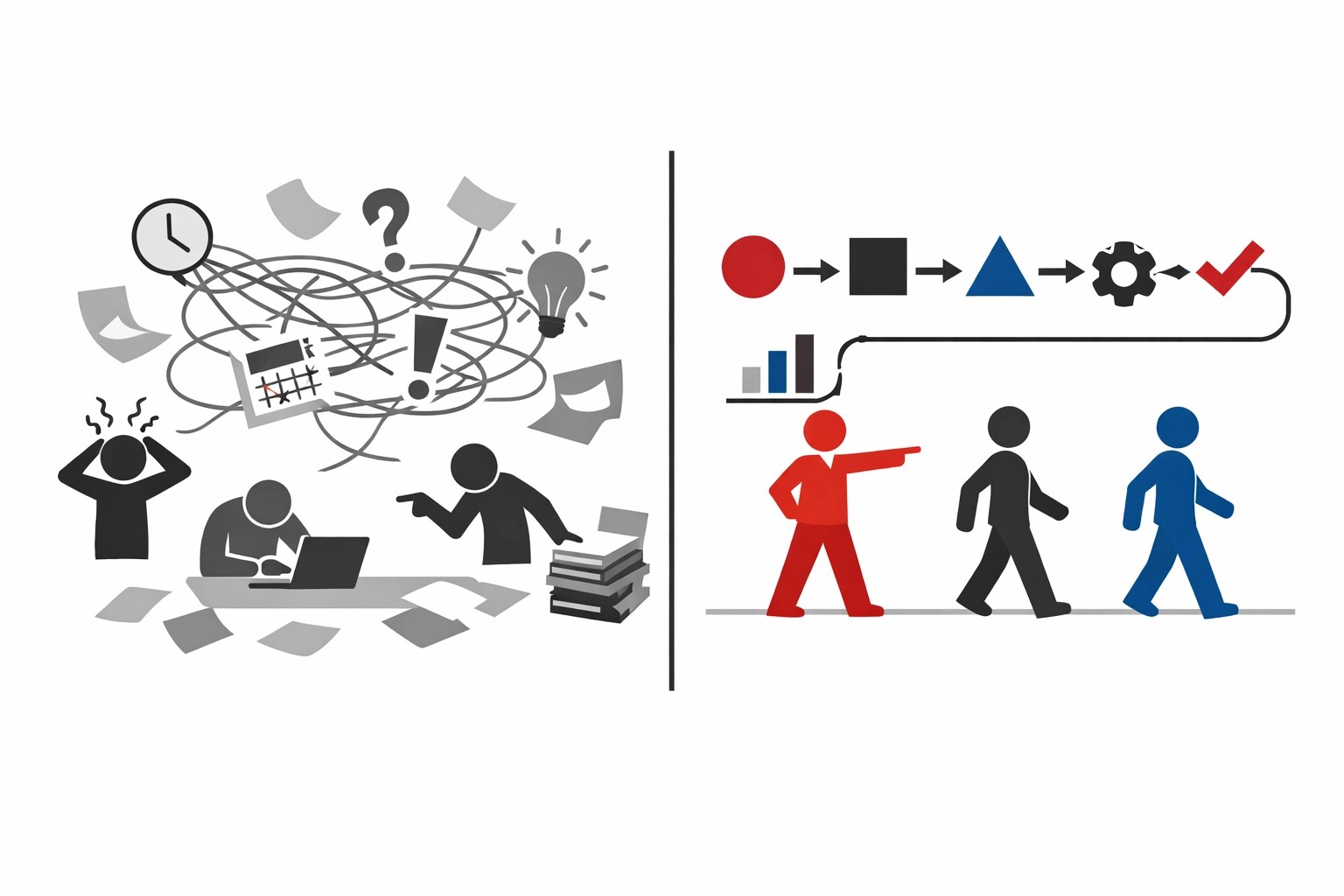
Here's what operational chaos actually looks like in non-profits:
- Board meetings where everyone debates the mission statement (again) instead of reviewing program metrics
- Staff who don't have clear processes for intake, service delivery, or documentation
- An Executive Director who can't take a vacation because they're the only one who knows where everything is
- Grant applications that take weeks to complete because data is scattered across multiple systems
- Programs that succeed because of individual heroics rather than repeatable systems
If you're reading this and feeling personally attacked... I get it. I've been there too (on both sides of the consulting table, if I'm honest).
What Operational Consulting Actually Does for Non-Profits
This is where process improvement consulting and organizational development consulting come in, and no, it's not just corporate buzzwords slapped onto non-profit work.
Real operational consulting for mission-driven organizations looks different than it does in the for-profit world. It has to.
When I work with non-profits through Solved., we're not handing over a 50-page report and walking away. That's not helpful. That's not how impact scales.
Instead, we're getting in the trenches with you to build operational systems that actually fit your reality, limited budgets, small teams, big hearts, and even bigger goals.
This might mean:
Mapping your actual workflow (not the idealized version in your head) so you can see where things break down. Maybe your intake process works fine for five clients a month but falls apart at fifteen. We need to know that before you hire more staff or expand programs.
Creating documentation that humans can actually use. Not corporate policy manuals. Simple, clear processes that help your team deliver consistent quality, whether your star employee is out sick or a new volunteer needs to jump in.
Aligning your resources with your strategy. This is where operations management consulting gets real. Are you spending 60% of your budget on a program that serves 15% of your mission? Maybe that's intentional... or maybe it's just what you've always done. We need to look at that honestly.
Building measurement systems that don't require a data scientist. You need to know what's working. Not in six months when you're writing your annual report, but now, while you can still adjust.

The Balance That Actually Matters
Here's something I've learned (sometimes the hard way): Every non-profit needs to balance visionary mission work with the day-to-day operational realities.
You can't just live in the clouds talking about your theory of change. But you also can't get so buried in operational minutiae that you lose sight of why you're doing this work in the first place.
The sweet spot? It's when your operations become the vehicle that accelerates your mission instead of the anchor that holds it back.
I worked with a youth development non-profit last year that had an incredible mission, providing mentorship and career pathways for underserved teens. But they were stuck at 40 participants because their program model required intensive one-on-one matching and their matching process was... well, it was chaos. Manual. Time-intensive. Inconsistent.
We didn't change their mission. We didn't compromise their values or water down their program quality.
We just built better operational systems, clearer criteria for matches, a simple tracking system, defined touchpoints throughout the mentorship journey. Within six months, they were serving 75 youth. Same staff. Same budget. Better operations.
That's what operational consulting can do when it's done right.
What This Looks Like in Practice
If you're a non-profit leader reading this and thinking, "Okay, maybe we do need help with operations..." here's what to look for:
Consultants who understand non-profit realities. The constraints you're working within: limited funding, volunteer labor, mission-first culture: aren't obstacles to work around. They're the context we're designing for.
Hands-on support, not just recommendations. A pretty PowerPoint deck doesn't change anything. You need someone willing to roll up their sleeves and implement alongside your team.
Process improvement that respects your people. Your staff didn't sign up for rigid corporate processes. We need operational systems that support autonomy and creativity while providing enough structure to ensure consistency and quality.
Organizational development that builds capacity. The goal isn't to make you dependent on consultants. It's to build internal capability so you can sustain and adapt these operational improvements long after we're gone.
At Solved., this is what we do. We help mission-driven organizations build the operational infrastructure they need to scale their impact without losing their soul in the process.
Your Mission Deserves Better Operations
If I'm honest, I think a lot of non-profit leaders avoid operational work because it feels less inspiring than mission work. It is less inspiring... until you realize that better operations mean serving more people, creating more impact, and actually changing more lives.
Your mission matters too much to let operational chaos limit your reach.
You don't need to choose between passionate mission focus and strong operational systems. You need both. And getting help to build those systems: through operational consulting and process improvement consulting: isn't a luxury. It's how you honor the mission by making sure you can actually deliver on it.
That Executive Director I mentioned at the beginning? We worked together for three months. Built some basic operational systems. Nothing fancy: just clear, repeatable processes for tracking families served, measuring outcomes, and managing program delivery.
Last month, she sent me an email. They'd just expanded to serve twice as many families. With the same staff. Same budget.
Different operations.
That's the power of getting this right.
Want to talk about what operational consulting could look like for your non-profit? Let's connect. I'd love to hear what challenges you're facing and how we might help you scale your mission without scaling your chaos.