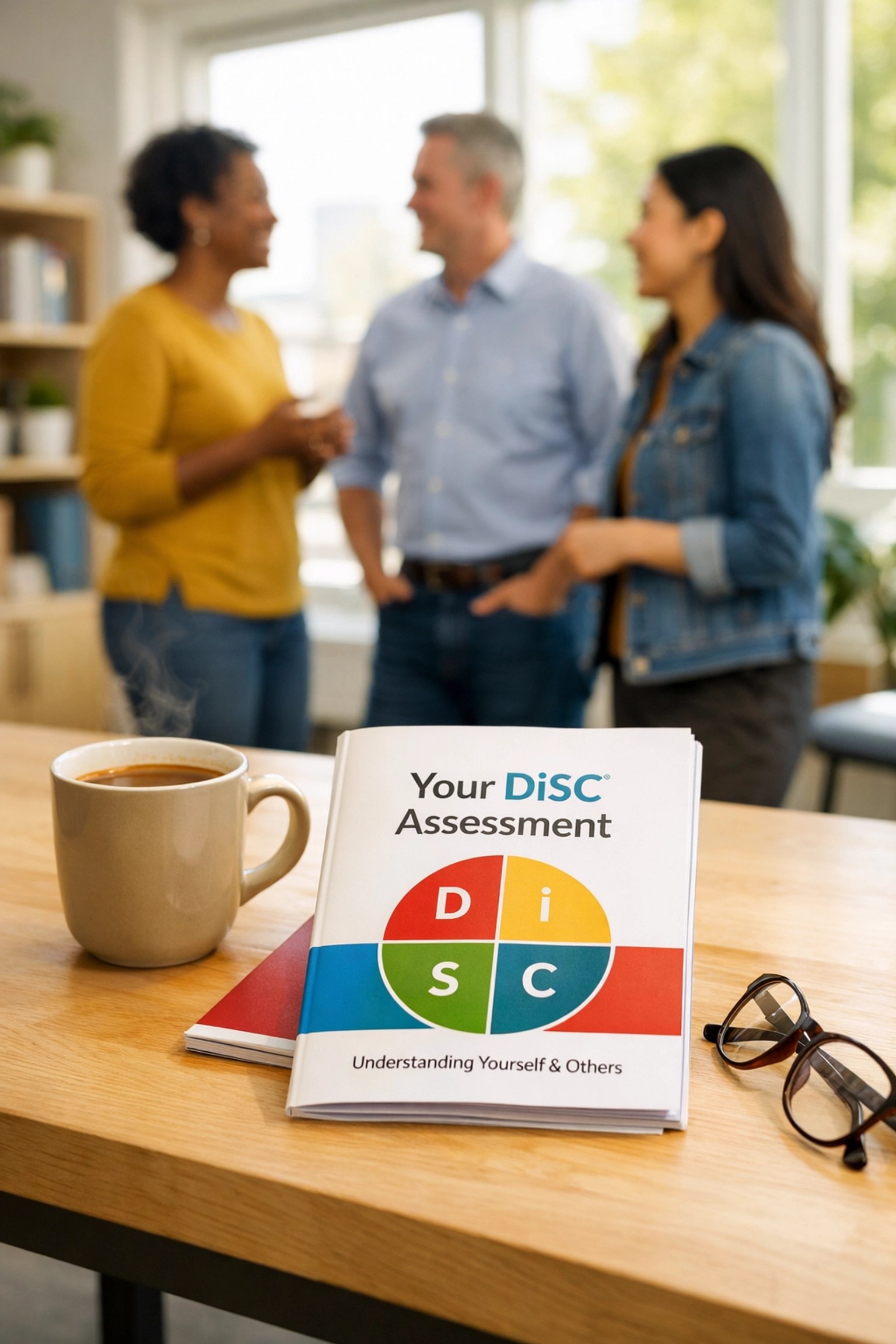
I remember sitting in a stuffy church basement about eight years ago, the kind that smells faintly of floor wax and old hymnals. We were in the middle of a staff retreat, and the air was thick with that "post-lunch" slump. Our facilitator had just handed out our DiSC profiles, and for about twenty minutes, the room was electric. We were laughing, pointing fingers, and saying things like, "Oh my gosh, that is so you!"
It felt like we had finally cracked the code to why the worship pastor and the children's director couldn't agree on a paint color. We felt seen. We felt understood.
But if I’m honest... by the following Tuesday, those colorful reports were buried under a pile of expense reports and volunteer schedules. By a month later, we were right back to the same old passive-aggressive emails and "meeting after the meeting" gripes.
I’ve seen this play out dozens of times in my 30+ years of working with organizations. Non-profits, especially, love DiSC. We’re "people people." We care about culture. But because we value "nice" and "mission-driven" so much, we often accidentally turn this incredibly powerful tool into a paperweight... or worse, a weapon.
If you feel like your team development has hit a wall, you might be making one of these seven mistakes. Don’t worry, I’ve made most of them myself. Let's look at how to fix them.
1. The "One and Done" Workshop Trap
This is the classic. You bring in a consultant (maybe even someone like me!), you have a great day of bonding, and then... nothing. You expect a four-hour workshop to solve ten years of communication debt.
It’s like going to the gym once, doing three sets of bicep curls, and wondering why you don't have a six-pack yet. DiSC isn't an event; it's a language. If you don't speak it every day, you’re going to lose your fluency. In the non-profit world, where we are constantly strapped for time, we tend to treat "professional development" as a box to check so we can get back to the "real work."
The Fix: You have to integrate it into the rhythm of your week. Put your DiSC styles in your email signatures. Mention them in your 1-on-1s. If you’re curious about how to make this stick longer than a weekend, I actually wrote a bit about why one workshop won't stick that might help.
2. Turning Profiles into Permanent Labels
"Oh, don't mind Sarah, she’s a High D. She’s just going to steamroll everyone, that’s just how she is."
Yikes. I’ve heard variations of this more times than I care to admit. When we use DiSC to label people, we aren't building bridges; we’re building cages. In non-profit cultures that lean heavily into the "S" (Steadiness) and "i" (Influence) quadrants, we often use the labels to avoid the hard work of actual conflict resolution.
We decide that because someone has a certain letter, they are incapable of certain behaviors. "He's a C, he'll never be good at the donor gala." That’s not just wrong; it’s limiting.
The Fix: Remind your team that DiSC is about preferences, not limitations. We all have all four styles within us; we just have different "comfort zones." Use the tool to ask, "How can we support Sarah in toning down the 'D' during this sensitive meeting?" rather than using it as an excuse to ignore her behavior.
3. Using Your Style as an Excuse for Bad Behavior
This is the flip side of labeling others, labeling ourselves to get out of growth.
I’ve been guilty of this. I’d say something blunt or dismissive and then follow it up with, "Well, you know, I’m just wired for results, I don't always have time for the fluff." (Translation: I was being a jerk and didn't want to apologize).
In a non-profit, we often hide behind our "natural style" because we are so focused on the mission that we think the "how" doesn't matter as much as the "what." But if our internal culture is toxic, our impact will eventually suffer.
The Fix: DiSC should be a mirror, not a "Get Out of Jail Free" card. If your assessment shows you struggle with empathy, that’s your cue to work harder on empathy, not an invitation to stop trying.
4. Hiring (and Firing) by the Letters
I’ve had leaders ask me, "Brett, should I only hire a High C for my bookkeeper?"
My answer is always a very firm... maybe?
Using DiSC as a primary hiring tool is a massive mistake. It’s not a measure of skill, IQ, or even "grit." I’ve known High i’s who were meticulous with data and High D’s who were incredibly patient mentors. If you use DiSC to screen people out, you’re likely creating a "mono-culture" that lacks the cognitive diversity you need to solve complex problems.
The Fix: Use DiSC during the onboarding process or late-stage interviews to understand how to manage the person, not whether to hire them. Focus on their experience and heart for the mission first. If you need help figuring out how a new hire fits into your operational puzzle, check out our operations consulting page.

5. Answering for the "Boss" (Assessment Dishonesty)
If your staff doesn't feel safe, they won't answer the assessment honestly. They’ll answer based on who they think they should be to get a promotion or to stay in your good graces.
In many non-profits, there’s a subtle pressure to be "nice" and "relational." As a result, you might see an overwhelming number of "S" and "i" profiles. But are they actually "S" types, or are they just trying to survive in a culture that punishes "D" behaviors? If the data is skewed, the training is useless.
The Fix: Before you ever send out an assessment link, talk about why you’re doing it. Emphasize that there is no "best" profile. Be vulnerable yourself, share your own struggles with your style. When the leader is honest about their flaws, the team feels safe to be honest about theirs.
6. Forgetting the "Why" (The Mission Connection)
Why are we doing DiSC training? Is it just because it's fun to talk about ourselves? (And let’s be real, it is fun).
In the non-profit sector, every dollar and every hour spent on training needs to point back to our impact. If your team doesn't see how understanding communication styles helps them serve more kids, rescue more animals, or feed more families, they will eventually see the training as a distraction from the "real work."
The Fix: Connect the dots for them. "If we understand each other better, we spend 20% less time in unproductive meetings and 20% more time on the front lines." Make it about the mission.
7. Treating it Like a Full Psychological Profile
DiSC is great. I love it. I use it constantly in my coaching practice. But it isn't everything. It doesn't measure your values, your ethics, your trauma, or your technical competence.
I’ve seen leaders try to use DiSC to diagnose deep-seated emotional issues in their staff. "Oh, he's just acting out because he's a frustrated High D." No... he might be acting out because he feels undervalued or because the organizational structure is a mess.
The Fix: Use DiSC for what it is: a behavioral tool. If there are deeper issues in your organization, you might need a more comprehensive strategic leader approach or even outside mediation. Don't ask a hammer to do the job of a screwdriver.
Putting it into Practice
Look, I’ve been around the block enough times to know that leadership is messy. It’s rarely as clean as the charts make it look. We’re all just people trying to do something good in the world, often with too little money and not enough sleep.
But that’s exactly why these tools matter. When we get the "people stuff" right, the "operational stuff" gets a whole lot easier.
If you’re sitting there thinking, "Brett, we did a DiSC thing three years ago and I haven't seen the binder since," don't beat yourself up. We’ve all been there. The good news is that you can start over today.
Have you ever seen a DiSC training go totally sideways? Or maybe you’ve seen it transform a team in a way you didn't expect? I’d love to hear your stories. If you’re ready to stop making these mistakes and actually use these tools to scale your impact, let's talk. You can find more about our approach at solvedoms.com/disc.
To be honest, I'm still learning how to manage my own "D" tendencies every single day... it’s a journey, right? Let's walk it together.