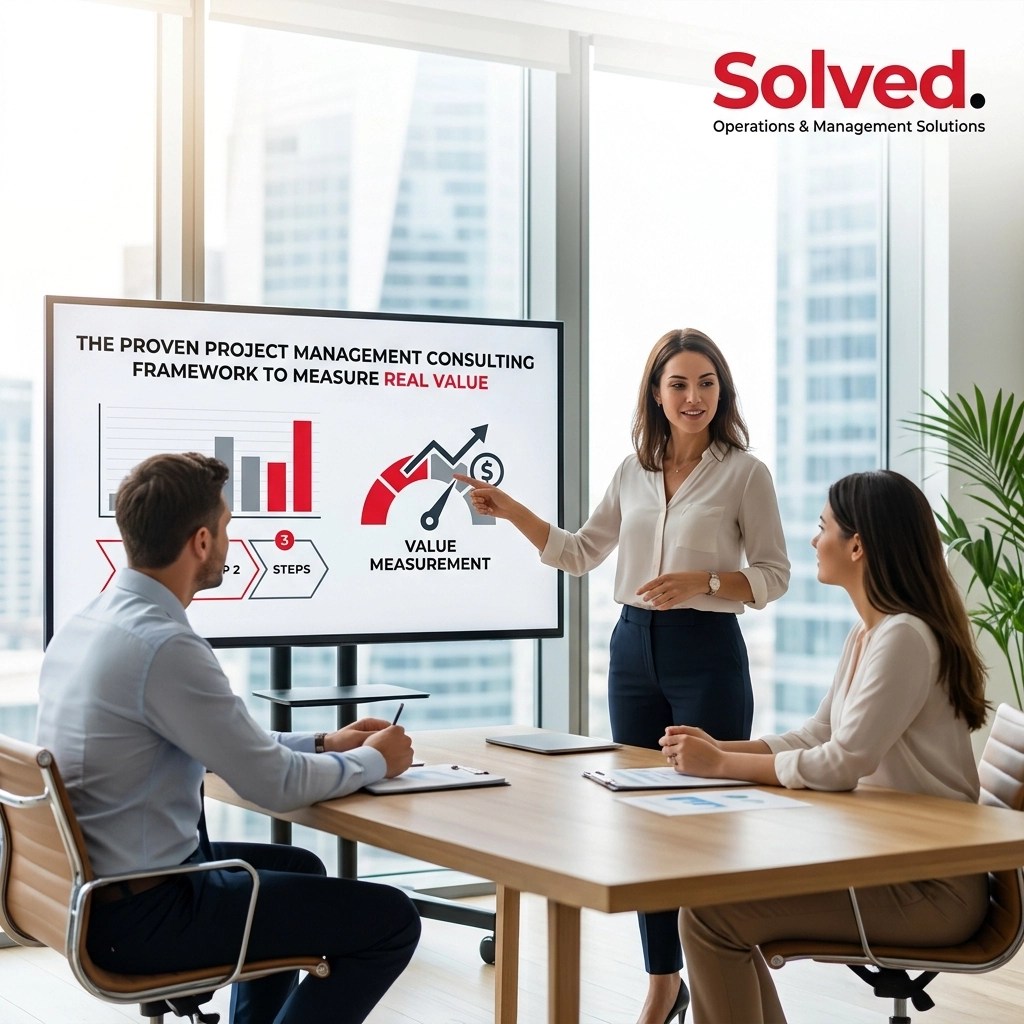
I’ll never forget the time I spent three weeks building the most beautiful, color-coded, multi-tabbed Gantt chart you’ve ever seen. It was a masterpiece of project management. I had dependencies mapped out, resource leveling calculated to the hour, and enough "critical path" lines to make a subway map look simple. I was so proud of it... until about four days into the project when the client looked at me and asked, "Brett, this is great, but how does this actually help us stop losing $10k a month in shipping errors?"
Yikes. I had fallen into the classic trap. I was managing the project, but I wasn't managing the value.
If I’m honest, I’ve done that more times than I’d like to admit. It’s easy to get lost in the "doing" and forget the "why." In the world of operational consulting, we often see leaders who are drowning in finished tasks but starving for actual results. They have a stack of completed projects, yet the needle hasn't moved on the bottom line.
That’s why, over the years at Solved. Operations & Management Solutions, we’ve leaned into a specific framework: one that’s less about checking boxes and more about measuring the messy, complicated, "real-world" impact of what we do.
The Problem with "On Time and On Budget"
We’ve all heard it. The holy trinity of project management: On Time, On Budget, Within Scope. If you hit those three, you’re a hero, right? Well... maybe.
You can build a bridge on time and on budget, but if no one lives on either side of the river, that bridge has zero value. In project management consulting, we see "ghost bridges" all the time. Software implemented that no one uses. New HR policies that everyone ignores. A "streamlined" workflow that actually adds three extra steps for the folks in the warehouse.
The "Solved." way of looking at things: our "in-the-trenches" philosophy: is that a project is only successful if it solves a tangible problem. It sounds simple, but it’s remarkably easy to lose sight of when you're in the thick of a 12-month rollout.

The Framework: DMAIC (with a Solved. Twist)
To keep ourselves honest, we often borrow from the Six Sigma playbook, specifically the DMAIC process. But because we’re a bit more casual (and let's be real, corporate jargon can be exhausting), we’ve adapted it to focus on human-centric operations consulting.
1. Define (The "Wait, Why are we doing this again?" Phase)
Before we even look at a project plan, we have to define what "value" actually looks like. It’s not just "implementing a new CRM." It’s "reducing lead response time by 20% so we stop losing deals to the guy down the street."
If you can’t state the value in one sentence that a fifth-grader (or a very tired CEO) can understand, you’re not ready to start. I've spent hours in discovery meetings just peeling back the layers of "we need this because everyone else has it" to find the actual operational pain point. It’s tedious... but it’s the only way to ensure we aren’t just spinning our wheels.
2. Measure (Data Doesn't Care About Your Feelings)
This is where it gets uncomfortable. To measure value, you need a baseline. If I’m helping a non-profit scale their impact: something we talk about here: we need to know exactly where they are starting.
Are your employees spending 4 hours a day on "admin"? Let’s track it. Is your board misaligned with your daily execution? (Check out our thoughts on that over here). We collect data on the "improvement needs" before we change a single thing.
3. Analyze (The "Root Cause" Reality Check)
This is where we play detective. Why are the shipping errors happening? Is it the software? Or is it because Jim in the warehouse is using a DiSC profile that thrives on speed but ignores the details, and he’s in the wrong seat? (If you’re wondering how personality plays into operations, this post on DiSC training is a good place to start).
In operational consulting, we find that the "root cause" is rarely what the client thinks it is. It’s almost always a breakdown in communication or a misalignment of roles.
4. Improve (Wet Cement Mode)
This is the execution phase. I call it "wet cement" because nothing should be set in stone yet. We implement solutions, but we do it with the humility to know we might have to pivot. If the new workflow isn't working for the team on the ground, we change it. Consistency is great, but consistency in a broken process is just a faster way to fail.
5. Control (Sustaining the Win)
This is where most projects die. The consultant leaves, the "new" wears off, and everyone goes back to their old habits. We use this phase to bake the changes into the company culture. It’s about creating systems that last long after I’ve driven away in my sedan.

Measuring the "Soft" Stuff
Now, I know what you’re thinking. "Brett, this is great for shipping errors, but what about team engagement? How do you measure the 'value' of a happy team?"
To be honest, that’s harder. But it’s not impossible. We look at retention rates, internal communication scores, and even the "vibe" of Monday morning meetings. If your team is constantly in conflict because they don't understand each other, that’s a massive operational cost. Using tools like DiSC assessments allows us to quantify the "un-quantifiable" and show the real ROI of a healthy culture.
Have you ever noticed how much time is wasted in meetings just trying to get on the same page? That’s an operational drain. When we tackle that through project management consulting, we aren't just making people "nicer": we are reclaiming billable hours.
Why You Need an Outside Eye
Look, I’m the owner of Solved., so obviously I’m biased... but even as someone who has been around the block, I still need outside perspectives on my own business. When you’re "in the trenches" every day, you develop blind spots. You start to accept inefficiencies as "just the way things are."
An operational consulting partner isn't there to tell you how to do your job. You're the expert at that. We're there to help you see the things that have become invisible. We help you measure the value of the things you're doing so you can stop doing the stuff that doesn't matter. (And trust me, we all have "stuff" that doesn't matter).

The Bottom Line
Real value isn't found in a polished report or a successful software go-live. It’s found in the clarity of your team, the efficiency of your processes, and the measurable impact on your mission: whether that’s profit-driven or purpose-driven.
If you’re feeling like your projects are moving but your business is standing still, it might be time to stop measuring "done" and start measuring "value." It’s a shift in mindset that changed how I work, and it’s the only way I know how to help you find the solutions that actually stick.
I’d love to hear how you’re measuring success in your own neck of the woods. Is it through hard numbers, or are you looking at the "human" side of operations? Feel free to reach out on our contact page: I'm always up for a conversation (and I promise not to bring a 40-tab spreadsheet unless you really want one).
Until next time, keep grinding... but make sure you're grinding on the right things.
- Brett