I’m sitting in a windowless conference room, the kind with those slightly sticky tables and the faint smell of industrial carpet cleaner, looking at a stack of twenty-five beautifully bound DiSC profiles. I’d spent thousands of dollars, and even more in billable hours, getting the whole team tested. We had the workshop. We laughed about the "High D" boss who probably didn't have a soul (guilty as charged, sometimes) and the "High S" team member who just wanted everyone to get along.
It was a great day. Truly.
Then, two weeks later, I walked past a trash can and saw one of those expensive binders sticking out from under a half-eaten salad.
Yikes.
If I’m honest... I’ve been that guy. I’ve been the leader who treats professional development like a flu shot, something you do once a year, it stings a little, and then you forget about it until the next season. But here’s the thing: DiSC isn’t a vaccination. It’s a language. And if you only speak a language one day a year, you’re going to be pretty terrible at communicating when the stakes actually matter.
At Solved. Operations & Management Solutions, we talk a lot about organizational development. But the "secret sauce" isn't in the fancy reports; it’s in how a manager uses those insights on a random Tuesday at 2:00 PM when a project is going off the rails.
The "Dusty Binder" Syndrome
We’ve all seen it. A company brings in a consultant, everyone learns they are an "i" (Influential) or a "C" (Conscientious), and they put a little sticker on their laptop. Then, the stress hits. A deadline looms. And suddenly, all that "understanding" goes out the window. We revert to our factory settings, usually the loudest or most aggressive version of ourselves.
If you’re like me, you’ve probably realized that knowledge without application is just trivia. And I don’t want my managers to be good at personality trivia; I want them to be good at leading humans.
To fix this, we have to stop treating DiSC as an event and start treating it as a tool in the daily kit. It needs to be as accessible as your calendar or your task manager.
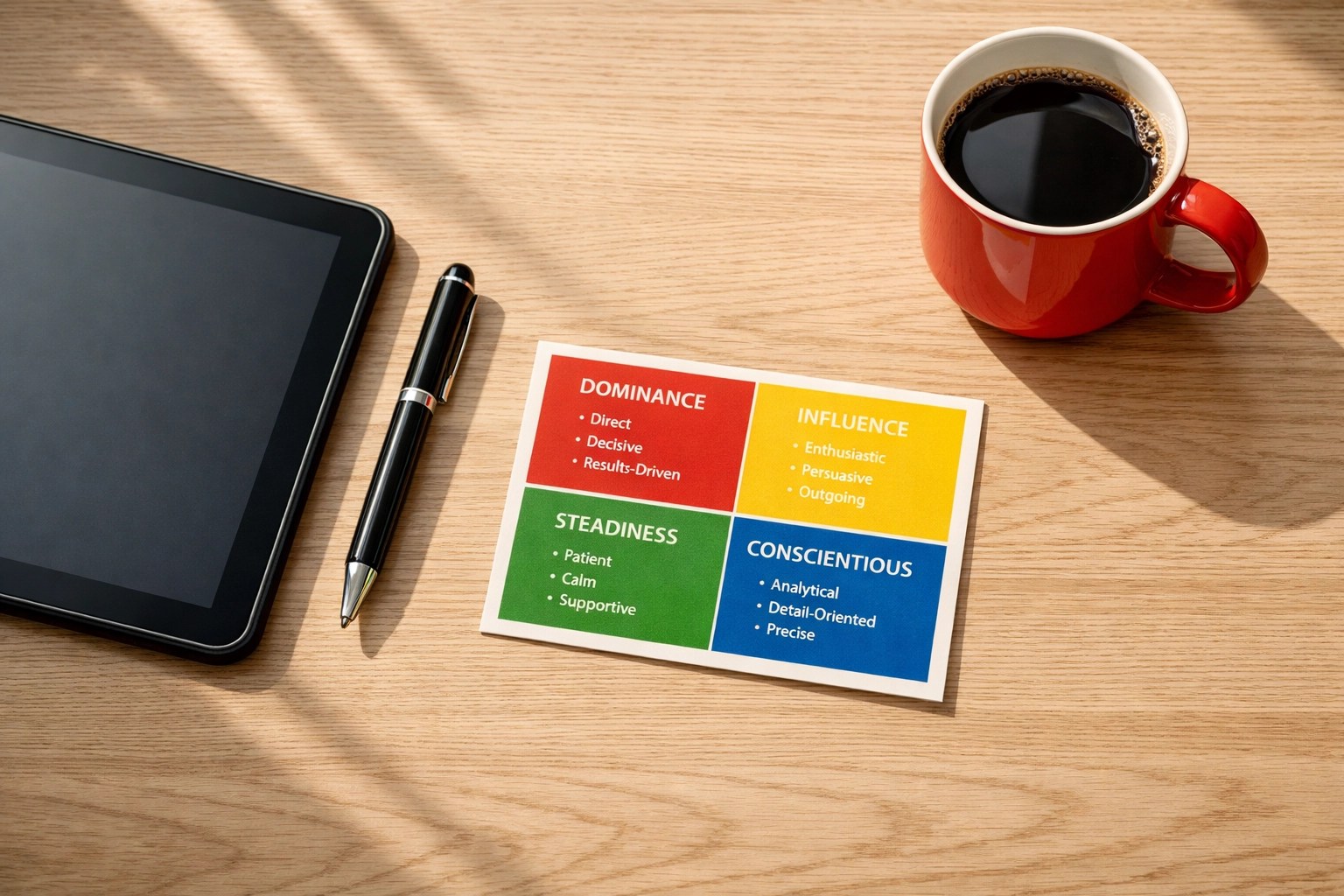
Integrating DiSC into the 1-on-1 Routine
The most practical place to start is the 1-on-1 meeting. If your managers aren't looking at a team member’s DiSC profile before they sit down for that check-in, they’re missing an open goal.
I used to just "wing it" in my 1-on-1s. I’d show up, ask "How’s it going?", and hope for the best. (Spoiler: It didn't always work this way, and I often left feeling like I’d missed something important).
Now, I suggest a different approach. Every manager should have a "Cheat Sheet" in their toolkit. Before a 1-on-1 with a High S (Steadiness), a manager should remind themselves: Slow down. Ask about the "how," not just the "what." Give them space to process.
Conversely, when I’m talking to a High D (Dominance), I need to get to the point. Fast. They don’t want the 15-minute preamble about my weekend; they want to know the bottom line.
It sounds simple, but it’s actually really hard to do consistently. It requires a level of intentionality that most of us (myself included) struggle with when we’re busy. But when you bake it into the "Manager Toolkit", maybe as a literal checklist in their coaching notes, it becomes a habit.
Using DiSC to Reduce, Route, and Resolve
If you’ve followed our work for a while, you know I’m obsessed with the Reduce → Route → Resolve framework. It’s how we keep operations from becoming a chaotic mess. Interestingly, DiSC is the perfect lens for this.
- Reduce: Sometimes we have tasks that simply don’t move the needle. But often, we struggle to "reduce" because we’re afraid of the conflict. A manager who understands DiSC knows that a High C might struggle to let go of a task because they want it done perfectly, even if it’s not important. Understanding that fear allows the manager to help them prune the "wet cement" of their to-do list.
- Route: This is where DiSC shines. Routing is about delegating to the natural owner with the right context. If I have a project that requires deep data analysis and zero errors, I’m not routing that to my most "High i" social butterfly. I’m routing it to my "C." But, and this is the key, I have to route it in their language.
- Resolve: Managers should only handle what requires their specific judgment. If a manager understands the DiSC profiles of their team, they can empower those individuals to resolve issues themselves by playing to their strengths.
https://cdn.marblism.com/S1dYFiFs-nk.png
The "Email Hack" for Daily Communication
Communication is where most operations break down. I’ve sent emails that I thought were "concise" but my team read as "angry." (I know... it's a classic High D problem).
One way to integrate DiSC into the daily toolkit is a simple email rule: Know your reader.
- Writing to a D: Bullet points. Results first. No fluff.
- Writing to an i: Start with a personal note. Use enthusiastic language. (I know it feels "extra" to some of you, but it matters).
- Writing to an S: Be gentle. Provide context. Don't spring major changes on them via a Friday afternoon "we need to talk" email. (Yikes, please don't do that).
- Writing to a C: Provide the data. Be logical. Expect follow-up questions and don't take them as a challenge to your authority, they just want to be right.
If you can get your managers to spend just 30 seconds thinking about the recipient's DiSC style before hitting "send," you’ll see team engagement skyrocket. It stops being about "personality" and starts being about "efficiency."
Moving Toward Executive Director Independence
In our consulting work, we often evaluate an Executive Director (ED) based on how independent the organization is from them. A "hero leader" who has to make every decision is actually a bottleneck.
Integrating DiSC into the manager toolkit is a massive step toward this independence. When your managers understand how to communicate and delegate effectively using DiSC, they stop running to the ED for every interpersonal conflict. They have the tools to resolve team conflict on their own.

I’ve seen organizations where the ED was the only one who "understood" the team. That’s a recipe for burnout. By distributing this "DiSC literacy" across the whole management layer, you’re ensuring that:
- Decisions are made at the right levels.
- Key relationships are distributed, not concentrated in one person.
- Work continues smoothly even when the "Boss" is on vacation.
It’s a Practice, Not a Project
I’m still learning this. Even after 30+ years in the game, I still occasionally bulldoze over a "High S" colleague because I’m in a rush. I still forget to provide enough detail for a "High C" and then wonder why they’re asking so many questions.
Leadership is messy. It’s contradictory. Sometimes you do things you absolutely despise just because you’re tired.
But having DiSC training integrated into your toolkit gives you a map when you’re lost. It’s not about being a "guru" who never makes a mistake; it’s about being a "fellow traveler" who has a better way to navigate the road.
If you’re looking to move past the "one-time workshop" phase, start small. Put the DiSC quadrants in your meeting rooms. Add a "DiSC Style" field to your 1-on-1 templates. Heck, put it in your Slack profiles.
The goal isn't to label people: it's to love them better through better communication. Or, at the very least, to stop annoying them quite so much.
I’d love to hear how you’re using these tools in your own daily routines. Have you found a "hack" that works for your team? Or are you still struggling to get those binders off the shelf?
If you're ready to actually implement this rather than just talking about it, let’s chat. You can contact us here to see how we can help your team move from "knowing" to "doing."
...because at the end of the day, a tool you don't use is just clutter. And we’re in the business of solving problems, not adding to the pile.
Practical Takeaways for Your Managers:
- The 30-Second Review: Before any high-stakes meeting or email, spend 30 seconds reviewing the other person's DiSC style.
- The Language Shift: Practice "mirroring" the communication style of the person you are delegating to.
- The Routing Check: Ask yourself: "Am I routing this task to this person because they are available, or because their DiSC style makes them the natural owner?"
- The Feedback Loop: Ask your team, "Am I communicating with you in a way that works for you?" (This one takes some vulnerability, but I promise it's worth it).
Let’s stop wasting time on miscommunication. It's expensive, it's draining, and frankly, we’ve got better things to do.
Stay focused,
Brett