I remember sitting in a cramped, windowless conference room about eight years ago... the kind of room that smells faintly of stale coffee and whiteboard markers. I was sitting in the back, watching an Executive Director and a Lead Project Manager go at it. Not shouting, it was worse than that. It was that polite, icy tension where everyone else in the room just stares at their notebooks.
The ED wanted a "visionary leap." The PM wanted a "documented spreadsheet."
They weren't actually arguing about the project. They were speaking two completely different languages, but neither of them had a translator. I sat there thinking, “If we just knew how the other person’s brain was wired, we’d be out of here in ten minutes.”
Fast forward to 2026, and honestly? Not much has changed with human nature, even if the tech has. We’ve got AI agents handling our calendars and operational consulting and AI changing how we manage tasks, but the "people" part? It’s still as messy as ever.
That’s why I’m obsessed with the idea of a Behavioral Dashboard.
The "People" Data You’re Missing
We have dashboards for everything now. We track KPIs, MRR, lead conversions, and server uptime. But if you’re a leader, your most important "engine" is the team. And most of us are driving that engine without a single gauge on the dashboard.
When I talk about DiSC training, I’m not talking about some "kumbaya" personality test that you do once and then file away in a drawer. I’m talking about building a real-time behavioral dashboard for your organization.
If you aren't familiar with the layout we use at Solved. Operations & Management Solutions, it looks like this:
- D (Dominance) – Top Left: Fast-paced, task-oriented, direct.
- i (Influence) – Top Right: Fast-paced, people-oriented, enthusiastic.
- S (Steadiness) – Bottom Right: Even-paced, people-oriented, supportive.
- C (Conscientiousness) – Bottom Left: Even-paced, task-oriented, analytical.

When you look at your team through this lens, the "icy tension" in that conference room starts to make sense. The ED was a high i (visionary/enthusiastic) and the PM was a high C (analytical/accurate). They weren't being difficult; they were just operating from different corners of the dashboard.
Why 2026 Demands This (The "Nice Culture" Trap)
We’re seeing a lot of "nice cultures" lately, especially in the non-profit and ministry spaces we work with. And look, I love nice people. But "nice" can be a mask for "terrified of conflict."
I’ve seen organizations stall out for years because they didn't know how to navigate tough conversations. They thought being "nice" meant never disagreeing. Yikes. If you're struggling with this, you might want to check out how to use DiSC to navigate tough conversations in ministry.
In 2026, the pace of work is too fast for "nice" to be a substitute for "effective." You need a behavioral dashboard so you can stop guessing why your team engagement strategies are falling flat. (By the way, if they are falling flat, here are 10 reasons why).
Triage Your Team: Reduce, Route, Resolve
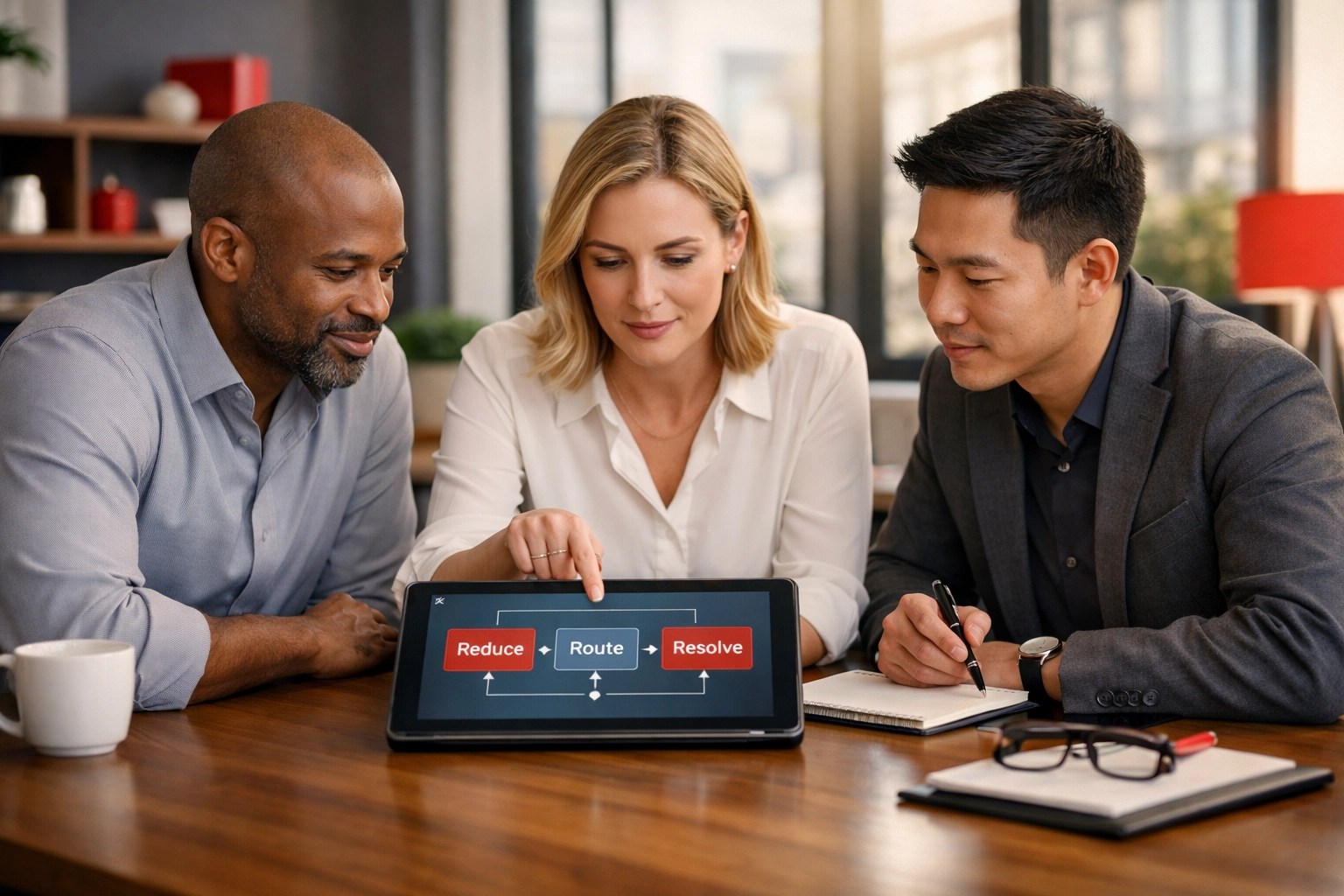
At Solved., I always teach our triage framework: Reduce → Route → Resolve. It’s usually for operations, but it works perfectly for team dynamics when you have a DiSC-informed dashboard.
- Reduce: Once you understand your team's styles, you can stop the "busy work" of miscommunication. You reduce the friction. If I know my developer is a high C, I’m going to stop sending him "vague, high-level ideas" via Slack at 9 PM. That just stresses him out and wastes his time. I reduce the noise.
- Route: This is about delegation. You route tasks to the natural owner. Need someone to rally the troops for a new launch? Route it to the i. Need someone to find the three errors in a 50-page contract? Route it to the C.
- Resolve: You handle only the things that actually require your specific judgment. When you know your team can communicate effectively without you, you can finally stop playing "referee."
Is Your Team Independent of You?
Here is the "gut check" for every Executive Director or Business Owner reading this. If you went on a three-week vacation tomorrow (without your phone), would your team's communication fall apart?
If the answer is "yes," you don't have a team; you have a collection of people waiting for your instructions.
A key part of operational consulting is evaluating ED independence. We look for:
- Decisions made at appropriate levels: Are your S and C types empowered to make calls on process without asking you?
- Distributed Relationships: Does the "vision" live only in your head, or is it distributed across the styles?
- Documented Priorities: Are they accessible? Or are they locked in your "High D" brain?
If you’re the only one who knows how to talk to everyone, you’ve created a bottleneck. You’re the single point of failure for the entire culture. (I know, that’s a bit blunt... but someone had to say it).
7 Mistakes You’re Probably Making (I Know I Did)
I’ve been doing this for a long time, over 30 years in various leadership roles, and I still mess this up. To be honest, I used to think DiSC was just a "fun activity" for a retreat.
It’s not. It’s an operational tool.
If you’re running DiSC training and it’s not sticking, you’re likely making one of the 7 mistakes we see in non-profit cultures. The biggest one? Using it as a label rather than a tool. "Oh, Sarah is just a High D, that's why she's being rude." No. That's using DiSC as an excuse for bad behavior.
The real goal is to say, "Sarah is a High D, so she values efficiency. If I want this meeting to be productive for her, I need to get to the point." See the difference?
The Road to 2026 Engagement
The future of work isn't just about better software; it's about better human "operating systems."
When you implement a behavioral dashboard, you’re giving your team the gift of clarity. You’re moving from chaos to clarity, which is the only way to scale without burning everyone out.
Imagine a world where your board meetings are productive because you’ve aligned your vision with daily execution. Imagine a world where conflict is handled with curiosity instead of defensiveness.
It’s possible. But you have to start with the data.
If you’re ready to stop guessing and start leading with a dashboard, we’d love to help you build it. Whether it's through team engagement strategies or a deep dive into your operations, the goal is the same: an organization that can thrive with or without you in the room.

I’d love to hear from you... what’s the biggest communication "train wreck" you’ve witnessed lately? Was it a lack of data, or just a mismatch of styles? Drop us a line at our contact page.
Let’s get to work.
: Brett
Ready to scale your impact? Check out our latest blog posts or learn more about how better operations fuel your mission.