I’ll admit it... I’m a sucker for a shiny new app.
A few years back, I found myself staring at a screen for three hours, trying to "automate" a simple follow-up sequence for a project. I was convinced that if I could just get this one AI-powered tool to talk to my CRM, my life would be a breeze. I spent the afternoon building "zaps," tweaking prompts, and feeling like a tech wizard.
Then Monday hit.
The tool worked perfectly. It sent out twenty emails to clients who: if I had actually looked at my manual process: weren't supposed to get them. I hadn't defined the logic of who gets what and when; I just automated the mess I already had. I basically built a high-speed lane for my own mistakes. Yikes.
If you’re a business owner or a manager right now, you’re likely feeling the pressure to "get on the AI train" before it leaves the station. But here’s the thing I’ve learned from being in the trenches with Solved. Operations & Management Solutions: Automating a broken process just makes it break faster.
Before you sign that next SaaS contract or hire a prompt engineer, we need to talk about process improvement consulting: the unsexy, high-ROI work that actually makes the tech worth it.
The "Garbage In, GPT Out" Problem
We see it all the time in our operational consulting work. A team is struggling with communication, so they buy a fancy project management tool with all the AI bells and whistles. Six months later, the tool is a digital graveyard of half-finished tasks and "overdue" notifications that everyone ignores.
Why? Because the tool didn't fix the fact that nobody knew who was responsible for what in the first place. (If that sounds familiar, you might want to check out our post on team engagement strategies).
If I’m honest, it’s easier to buy software than it is to sit in a room with your team and map out exactly how work gets done. One costs money; the other costs vulnerability and hard thinking. But if you want a real return on investment, you have to do the heavy lifting of process improvement first.

Before you automate, make sure you've solved the underlying process.
The Framework: Making "The Trenches" Systematic
When we go into a business to help with process improvement, we don't just guess. We use a version of the DMAIC model: it’s a Six Sigma thing, but don't let the jargon scare you off. It’s actually a very practical way to look at the world... even for those of us who prefer a casual conversation over a spreadsheet.
1. Define: What Are We Actually Doing Here?
Most "problems" in a business are actually symptoms. "We need more sales" might actually mean "Our onboarding process is so slow that customers cancel before we even start."
You have to define the actual goal. Is it speed? Is it quality? Is it reducing the number of times I have to apologize to a client because we dropped the ball? (Believe me, I’ve been there... those apology calls are the worst).
2. Measure: Face the Music (and the Data)
This is where it gets uncomfortable. You have to look at the numbers. How long does a task really take? Not how long you think it takes, or how long it should take in a perfect world where no one gets sick and the internet never goes down.
We often find that when we start measuring, the "bottleneck" isn't where the boss thinks it is. It’s usually tucked away in a tiny hand-off between departments that everyone assumes is "fine."
3. Analyze: The Root Cause (The "Why" Behind the "Sigh")
Have you ever sat in a meeting and realized everyone is just venting? That’s not analysis. Analysis is digging past the surface until you find the root cause.
Maybe your team isn't "lazy": maybe they lack the DiSC training to understand how to communicate clearly with each other. Or maybe the process is so convoluted that "cutting corners" is the only way they can survive the day.
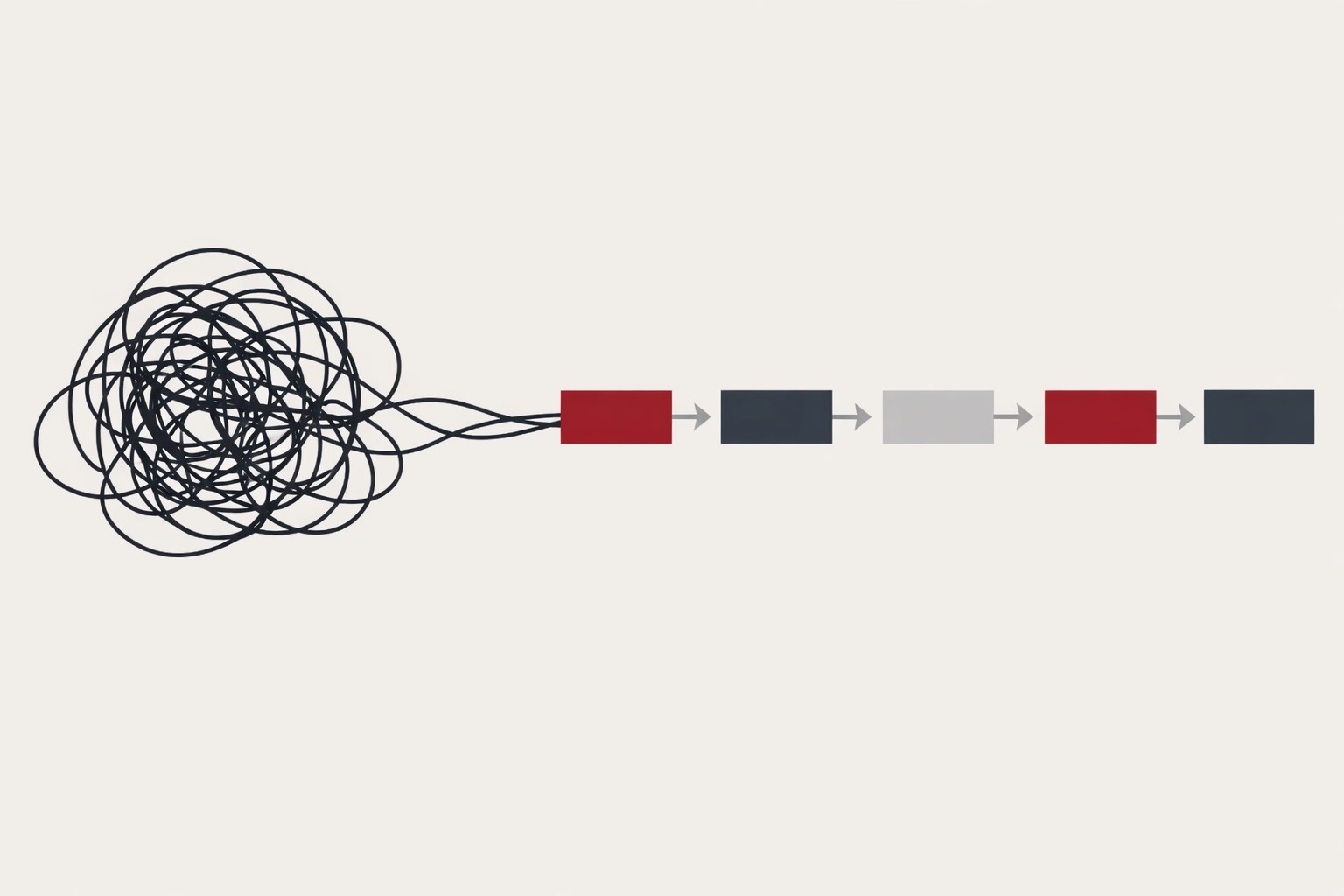
(Graphic idea: A flowchart showing a messy "Before" process vs. a streamlined "After" process, with the Solved. logo overlay: https://cdn.marblism.com/bz2rtr9YWQu.png and data-featured="true")
4. Improve: The "In-The-Trenches" Fix
Now, and only now, do we start changing things. We map the new process. We remove the steps that add zero value. We simplify.
This is the stage where you might realize you don't actually need that $500/month AI tool. You might just need a clear checklist and a 10-minute morning huddle. Or, if you do decide to buy the tool, you now know exactly what you need it to do. You’re buying a solution, not a miracle.
5. Control: Don't Let the Cement Dry Wrong
Process improvement isn't a "one and done" thing. It’s like a garden: if you don't weed it, the mess comes back. You need to establish rhythms to make sure the new way of working sticks.
Why You Need an Outside Set of Eyes
I know what you’re thinking... "Brett, I know my business better than anyone. I can fix my own processes."
And you’re right, you do know it better. But you’re also in it. When you’re in the middle of the woods, it’s hard to see the path. You’re too busy dodging branches.
As a consultant at Solved., my job isn't to tell you how to run your business. My job is to hold up a mirror and ask the questions you’re too busy to ask yourself. Questions like:
- "Why do we do it this way?"
- "If this step disappeared tomorrow, would the customer notice?"
- "Are we doing this because it’s effective, or because it’s how we’ve always done it?"
It’s that "in-the-trenches" perspective. We aren't here to give you a 50-page PDF report that sits in a drawer. We’re here to roll up our sleeves, look at the messy reality of your daily operations, and help you find a better way.
The Quick-Start Checklist
If you’re itching to improve your operations today, start here (it’s cheaper than a new AI subscription, I promise):
- Pick ONE process. Don't try to fix the whole company. Pick the one that causes the most stress or the most "where is that file?" emails.
- Gather the "Doers." Not just the managers. The people who actually click the buttons. Ask them to walk you through the process step-by-step.
- Map it out. Use a whiteboard or a piece of paper. If it looks like a bowl of spaghetti, congratulations: you’ve found the problem.
- Identify the Waste. Look for "Wait" time (waiting for approvals), "Motion" (searching for info), and "Over-processing" (doing more work than the customer asked for).
- Simplify First, Automate Second. See if you can fix the problem by removing steps before you try to fix it by adding technology.
Final Thoughts (From a Fellow Traveler)
Look, I’m still learning too. Even as someone who has been around the block, I still catch myself trying to find a "tech shortcut" for a "people problem" or a "process problem." It’s human nature to want the easy button.
But true operational excellence comes from the discipline of doing the boring stuff well. It comes from having the right management solutions in place so your team can actually do the work they were hired to do.
If you’re feeling overwhelmed by the "AI revolution" and your current operations feel like they’re held together by duct tape and prayers... let’s chat. We’ve been in those trenches, and we know the way out.
I’d love to hear about the "shiny tool" that failed you, or the one process you wish you could just delete and start over. Drop me a note on our contact page. We’re all in this together, trying to build something that lasts.
Talk soon,
Brett Bortnem
Owner & Principal Consultant, Solved. Operations & Management Solutions