I remember sitting in a windowless conference room about eight years ago, staring at a stack of colorful reports and feeling... well, smug. I had just finished explaining to a room full of tired managers exactly why they were "clashing." I’d diagnosed them. I’d labeled them. I’d basically told a High C (Conscientiousness) manager that he was "too picky" and told a High I (Influence) director that she was "too loud."
I thought I was being a genius.
But as I looked around, I didn't see enlightenment. I saw crossed arms. I saw eye rolls. I saw people who felt boxed in, judged, and, to be honest, a little insulted. I had made the classic mistake of using DiSC as a weapon instead of a tool.
It took me a few more "messy" sessions to realize that simply handing out a PDF and talking about colors isn't training... it’s just entertainment. And expensive entertainment at that. If you've ever felt like your team's DiSC workshop was a "one and done" that didn't actually change the culture, you aren't alone. I’ve been there, and I’ve made just about every mistake in the book.
Here are the seven biggest mistakes I see (and have made) with DiSC assessment training, and how we can actually do better.
1. Treating DiSC Like a Soul-Level Personality Test
This is the big one. If I’m honest, I used to fall into this trap all the time. We tend to talk about DiSC as if it defines who a person is at their very core. We say things like, "Oh, Sarah is a D," as if that’s her entire identity.
But here’s the thing: DiSC doesn’t measure your personality. It doesn’t measure your values, your ethics, your intelligence, or your childhood trauma. It measures behavioral tendencies.
It’s about how you show up in a specific environment. When we treat it as a "complete" profile, we ignore the fact that people are incredibly complex. You can be a High D (Dominance) who is also deeply empathetic, or a High S (Steadiness) who is an incredible public speaker. When we oversimplify, we lose the human.
The Fix: Always frame DiSC as a "behavioral" tool. Remind your team that this is about how they communicate and complete tasks, not who they are as humans. It’s one piece of the puzzle, not the whole picture.
2. Playing Favorites (The "D" Bias)
I’ve seen this happen in so many corporate environments. There’s an unconscious bias that "D" (Dominance) and "I" (Influence) styles are "better" for leadership. We celebrate the fast-talkers and the risk-takers, and we accidentally make the "S" and "C" folks feel like they’re just the "support staff."
I remember working with a leadership team where the CEO was a "High D" and he openly joked that the "S" styles on the team were "too slow to keep up." Yikes. That’s a fast track to disengagement. Every style has a "dark side," but every style is also vital for a healthy operation.
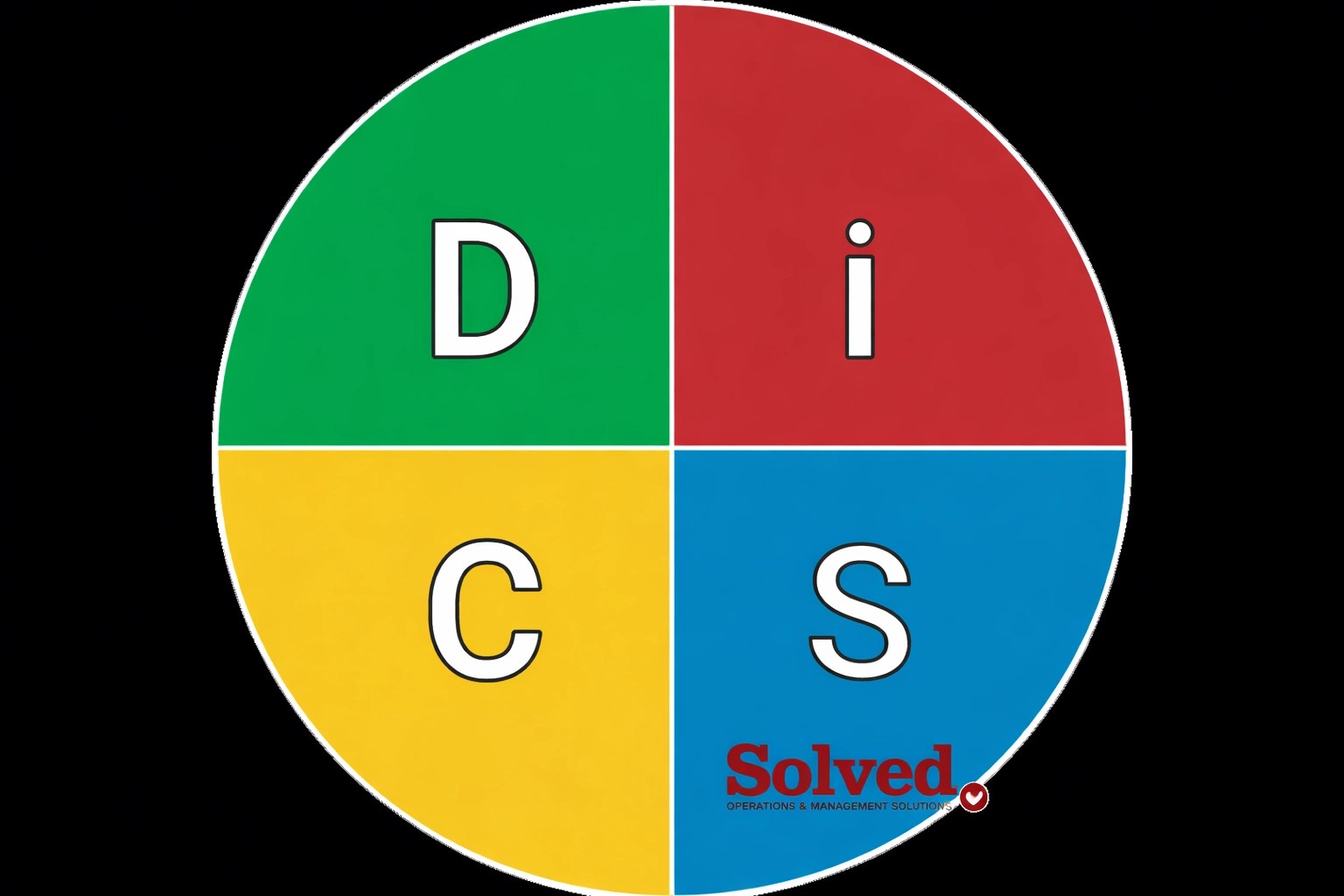
The Fix: As a leader or facilitator, you have to show equal appreciation. A team of all "D"s will drive the bus off a cliff because no one checked the brakes (the "C"s) or made sure everyone was still on the bus (the "S"s). I talk a lot about this in my work at Solved. Operations & Management Solutions, true operational excellence requires the strengths of all four quadrants.
3. Being Too Vague About the "Focus"
When someone takes a DiSC assessment, they are answering questions based on a specific "mental mirror." If they are thinking about how they act at home with their kids, they’ll get one result. If they’re thinking about how they act when their boss is breathing down their neck, they might get another.
The mistake? Not giving your team a specific "reference point" before they hit "submit" on that assessment.
The Fix: Before they take the test, tell them: "Think about yourself in your current role at this company." This gives the data context. It makes the results actionable for the work environment. Without a focus, the data is just... blurry.
4. Ignoring the "Hidden" Data (The Three Diagrams)
Most people just look at their "dot" on the circle and call it a day. But if you’re using certain versions of DiSC (like the classic profiles), there are actually three different graphs that show your "Natural" style versus your "Adapted" style.
I once worked with a manager who showed up as a very high "D" in his adapted profile, but his natural style was a very high "S." He was literally exhausting himself every day trying to be someone he wasn't because he thought that’s what the job required. He was on the verge of burnout, and the DiSC graphs were the only thing that helped us see why.
The Fix: Don’t just look at the summary. Dive into the data. If you see a big gap between how someone naturally is and how they are behaving at work, that’s a conversation worth having. You can learn more about how we handle these deep dives on our coaching page.
5. Playing the "Expert" and Forcing Results
Have you ever had someone tell you, "Well, the test says you're argumentative, so you must be"? It’s infuriating.
Sometimes, a participant will look at their report and say, "This isn't me." The worst thing a trainer can do is tell them they’re wrong. Maybe they were having a bad day when they took it. Maybe they misunderstood the questions. Or maybe... the test just missed the mark this time.
The Fix: Believe them. If someone says, "This doesn't resonate," use it as a starting point for a conversation. Ask, "Which parts do feel like you? Which parts feel off?" The goal isn't to get them to agree with a computer algorithm; the goal is to increase self-awareness.
6. Using "Color" Language to Pigeonhole People
"Oh, don't mind him, he's just being a typical Blue (C)."
"We can't give this project to her, she's an 'I' and won't finish the paperwork."
I hate this. I really do. Even as someone who has been around the block with these tools for years, I still catch myself doing it occasionally. It’s lazy leadership. We use DiSC labels to put people in boxes rather than using them to build bridges.
When we use stereotyping language, we actually discourage people from growing. We make them feel like their behavior is fixed. But the whole point of DiSC is adaptability.
The Fix: Use language that emphasizes choice. Instead of saying "He's a C," try "He tends to prioritize accuracy and data." It’s a subtle shift, but it moves the conversation from a permanent label to a behavioral preference. If you're struggling with this in a church or ministry context, check out this post on using DiSC to navigate tough conversations.
7. Expecting DiSC to Predict Job Success
This might be the most dangerous mistake of all. I’ve had clients ask me, "Can we use DiSC to hire our next Sales Manager? We only want High Is."
My answer is always a hard "No." (Well, a polite "No," but I mean it firmly).
DiSC is not a hiring tool. It doesn’t measure skill. It doesn’t measure experience. There are plenty of "High D" leaders who are absolute failures and "High S" leaders who are world-class. If you use DiSC to decide who gets a promotion or who gets hired, you’re opening yourself up to a world of bias and potentially missing out on incredible talent.
The Fix: Use DiSC for onboarding and development, not for selection. Use it to understand how to communicate with your new hire, not to decide if they can do the job. Success in a role is about way more than just behavioral style: it’s about strategic leadership and operational rhythm.
Why "One and Done" Doesn't Work
If I’ve learned anything in my time at Solved. Operations & Management Solutions, it’s that culture isn't built in a three-hour workshop. It’s built in the "wet cement" of daily interactions.
Most DiSC training fails because it stays in the classroom. We have a fun day, we laugh at our "types," and then we go back to our desks and send the same passive-aggressive emails we’ve always sent. To make it stick, you have to integrate it into your operational rhythms.
I’m still learning this, too. Even now, I have to catch myself when I’m getting frustrated with a colleague whose style is different from mine. I have to remind myself that their "need for more data" isn't a personal attack on my "need for speed." It’s just a different way of seeing the world.
Putting it into Practice
So, if you’re looking at your team and thinking, "We need a reset," don't just book another generic workshop.
- Be Vulnerable: Start by sharing your own profile and where you struggle. (I’m a High D/I, and I struggle with slow-moving meetings and detailed spreadsheets. Just ask my team... they’ll tell you).
- Focus on Conflict: Use DiSC to talk about how you disagree. That’s where the real juice is.
- Keep it Alive: Mention DiSC styles in your 1-on-1s. Use it to prep for big projects.
DiSC is a powerful tool, but like any tool, it depends on the hand that’s holding it. If you use it to label and limit, it’ll fail every time. But if you use it to understand and adapt? That’s when the magic happens.
I’d love to hear about your experiences: the good, the bad, and the "oh-no-what-did-I-just-say" moments. Have you seen these mistakes in your own workplace? Or maybe you've found a way to make DiSC really "stick" for your team?
If you're ready to move beyond the "one-off workshop" and actually build a culture of high engagement and operational excellence, let’s chat. I promise not to label you. (Unless you really want me to...)
- Brett